Last Reviewed/Updated: June 2026
Written by: Femmenest Editorial Team
Medically Reviewed by: Dr. Sowjanya Aggarwal, MS (Obstetrics & Gynaecology); Fellowship in Minimal Access Surgery & Reproductive Medicine — Director, IVF & Infertility and Laparoscopic & Robotic Gynae Surgery, Femmenest Centre for IVF Gynaecology
Disclaimer: This article is for general informational purposes only and is not a substitute for professional medical advice, diagnosis, or treatment. Please consult a qualified gynaecologist or fertility specialist about your specific situation.
Key Takeaways
- A fresh embryo transfer happens 3–5 days after egg retrieval, in the same cycle. A frozen embryo transfer (FET) uses embryos that were vitrified (flash-frozen) and transferred in a later cycle, once hormone levels have settled.
- Research on this comparison is mixed and depends heavily on the patient's specific situation — for many women with a normal response to stimulation, fresh and frozen transfers have shown broadly similar success rates.
- Frozen transfer is generally recommended for patients at higher risk of ovarian hyperstimulation syndrome (OHSS), those doing genetic testing (PGT) on embryos, or those with high progesterone/estrogen levels that may affect the uterine lining.
- Neither option is inherently "better" — current evidence suggests the right choice depends on your ovarian response, hormone levels, and treatment goals, which is why this is a decision made together with your fertility specialist, not a one-size-fits-all rule.
What's the Difference, Exactly?
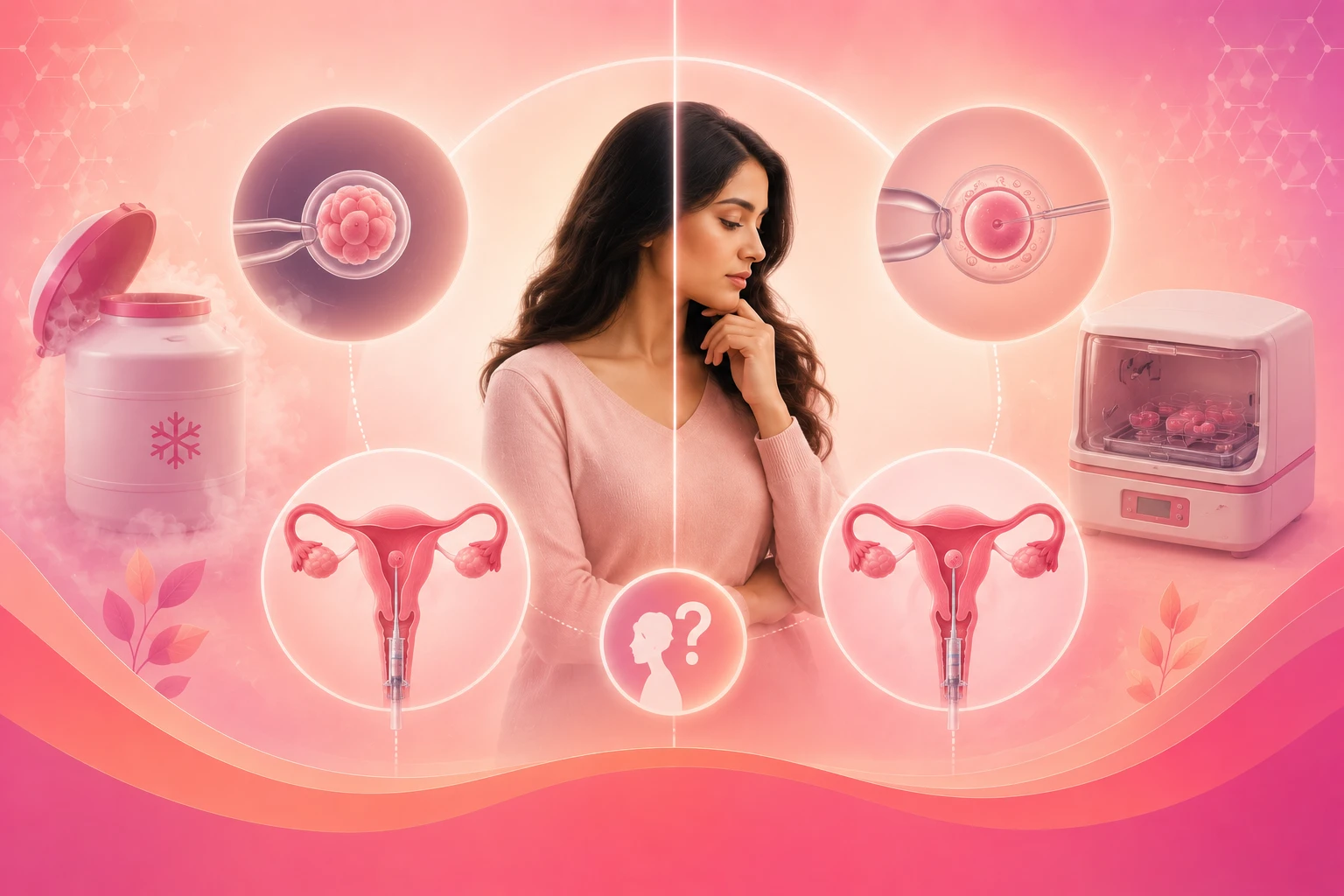
Both fresh and frozen embryo transfer are part of the same IVF process — the difference is in timing, not in how the embryo is created.
- Fresh embryo transfer: After egg retrieval and fertilisation in the lab, one (or sometimes two) embryos are transferred directly into the uterus, typically 3–5 days later, in the same stimulated cycle.
- Frozen embryo transfer (FET): Embryos are vitrified — a fast-freezing technique — and stored. They're thawed and transferred in a separate, later cycle, after the body has recovered from ovarian stimulation. This later cycle may be a natural cycle or a medicated one using oestrogen and progesterone support prescribed and monitored by your fertility team.
Over the last decade, FET has become far more common globally, largely because vitrification techniques have improved embryo survival rates after thawing, and because more clinics are using genetic testing (PGT-A), which requires embryos to be frozen while results are processed.
This article is for educational purposes — for general background on the IVF process itself, see our IVF and infertility treatment overview.
How Fertility Specialists Decide Between the Two
There's no single "correct" choice for every patient. Your fertility team will typically weigh a few factors:
Reasons your doctor may recommend a frozen transfer:
- High response to stimulation or risk of OHSS. When stimulation produces a large number of eggs or very high oestrogen levels, going ahead with a fresh transfer can raise the risk of ovarian hyperstimulation syndrome. Current ASRM guidance notes that choosing a "freeze-all" approach with a later frozen transfer meaningfully lowers the risk of moderate-to-severe OHSS compared with proceeding to fresh transfer (ASRM, 2023).
- Genetic testing of embryos (PGT-A/PGT-M). If embryos are being tested for chromosomal or genetic conditions before transfer, they need to be frozen while results are processed — a frozen transfer is then a practical necessity, not just a preference. Learn more about PGS/PGD testing.
- Elevated progesterone or a less receptive lining on stimulation day. Stimulation hormones can sometimes make the uterine lining less ready to receive an embryo in that same cycle; waiting allows the lining to return to a more natural state.
- PCOS or a history of high ovarian response. Some research has shown improved outcomes with frozen transfer specifically in patients with PCOS, where OHSS risk is already elevated.
Reasons your doctor may recommend a fresh transfer:
- A normal, moderate response to stimulation with no signs of OHSS risk.
- A healthy-appearing endometrial lining and hormone levels on the day of transfer.
- A personal or logistical preference to avoid extending the treatment timeline, when there's no medical reason to delay.
What Does the Research Actually Say About Success Rates?
This is where it's important to be precise, because headlines often oversimplify this. The honest picture is: outcomes depend on which group of patients is being studied.
- A landmark trial published in the New England Journal of Medicine compared fresh and frozen transfer in ovulatory women without PCOS and found no significant difference in live birth rates between the two approaches, while frozen transfer was associated with a lower risk of OHSS (NEJM).
- A separate body of research in women with PCOS or a high ovarian response has generally found frozen transfer associated with comparable or somewhat better live birth outcomes than fresh transfer, largely attributed to improved endometrial receptivity once stimulation hormones have cleared.
- In women with a normal response to stimulation, a propensity-matched cohort study found no significant difference in clinical pregnancy rates between a freeze-all approach and fresh transfer overall — though women aged 40 and older showed a higher clinical pregnancy rate with the freeze-all strategy (PMC, 2021).
- A review on freeze-all strategies similarly concluded that two large randomised trials found no live-birth advantage to freezing all embryos in normally-responding, ovulatory women, though OHSS risk was still meaningfully lower with the frozen approach (PMC review).
- In women of advanced maternal age, one single-centre study found no significant difference in live birth rate between fresh and frozen transfer, though the frozen group showed higher average birthweights and a lower preterm birth rate (PMC, 2022).
The takeaway: for many patients with a normal stimulation response, fresh and frozen transfer can offer comparable chances of success. For specific groups — high responders, PCOS, those needing genetic testing, or those at OHSS risk — the evidence currently leans toward frozen transfer being the safer, and sometimes more effective, choice. Success rates are also strongly influenced by age, embryo quality, and the number of prior cycles, which is why personalised guidance from your own fertility team matters more than any general statistic.
| |
Fresh Embryo Transfer |
Frozen Embryo Transfer (FET) |
| Timing |
3–5 days after egg retrieval, same cycle |
A later cycle, after hormone levels settle |
| OHSS risk |
Higher in high responders |
Substantially reduced |
| Genetic testing (PGT) |
Not compatible (results take time) |
Required if testing embryos |
| Treatment timeline |
Shorter overall |
Adds a few weeks to a couple of months |
| Best suited for |
Normal responders with a receptive lining |
High responders, PCOS, OHSS risk, PGT cycles, some cases of advanced maternal age |
When to Talk to Your Fertility Specialist
Because this decision is made during an active treatment cycle, it's worth flagging a few situations where you should raise concerns with your clinical team promptly rather than waiting for your next scheduled visit:
- Rapid abdominal swelling, bloating, or pain after your trigger injection or egg retrieval — these can be early signs of OHSS and should be assessed quickly.
- Nausea, vomiting, or reduced urination in the days following retrieval.
- Shortness of breath or significant weight gain over a day or two during stimulation.
- Any uncertainty about why a freeze-all approach has been recommended for your cycle specifically — it's reasonable to ask your doctor to walk you through the reasoning for your case.
If you experience any of the OHSS-related symptoms above, contact your fertility clinic the same day rather than waiting.
Frequently Asked Questions
Is frozen embryo transfer less effective than fresh transfer?
Not necessarily. Current evidence suggests outcomes are broadly comparable for many patients, and frozen transfer may be associated with better outcomes in specific groups, such as those with PCOS or a high ovarian response.
Does freezing damage the embryo?
Modern vitrification techniques have very high embryo survival rates after thawing. Your embryologist will discuss survival rates for your specific embryos as part of your individualised treatment plan.
Will a frozen transfer delay my chances of pregnancy?
It adds time to your treatment timeline — typically a few weeks to a couple of months, depending on your cycle type — but is not generally associated with reduced overall success when medically appropriate.
Can I choose which type of transfer I want?
Your fertility specialist's recommendation is based on your stimulation response, hormone levels, and any genetic testing plans. It's always worth discussing your preferences and the reasoning behind their recommendation together.
A Decision Best Made With Your Care Team
Neither fresh nor frozen transfer is universally "better" — current guidelines and evidence point to individualised decision-making based on how your body responds to stimulation, whether genetic testing is part of your plan, and your overall health picture. If you're currently in an IVF cycle and unsure which path is being recommended for you and why, that's a completely reasonable question to bring to your next appointment.
If you're early in exploring your options, our team can walk you through what to expect at each stage — read more about what happens after a frozen embryo transfer, or get in touch to discuss your specific situation.


 +91-7827475131
 contact@femmenest.com
 IVF and Infertility
 Gynaecology
 Robotic Gynecology
 Laparoscopic Surgery
 Fetal Medicine
 Birthing
 Hysteroscopy

 Home
Home