


 +91-7827475131
 contact@femmenest.com
 IVF and Infertility
 Gynaecology
 Robotic Gynecology
 Laparoscopic Surgery
 Fetal Medicine
 Birthing
 Hysteroscopy



Hysteroscopic myomectomy is a day-care, no-incision procedure that removes fibroids growing inside the uterine cavity (submucosal fibroids) using a thin camera-guided instrument passed through the vagina and cervix. At Femmenest in Delhi NCR, our gynecologic surgeons use this technique to treat heavy bleeding, pelvic discomfort, and fibroid-related fertility issues — while preserving the uterus, with most patients going home the same day.
Book a Consultation with Our Specialists →
Hysteroscopic myomectomy is a minimally invasive surgery used to remove uterine fibroids that bulge into the uterine cavity. Unlike open or laparoscopic surgery, it is performed entirely through the natural passage of the vagina and cervix — there are no cuts on the abdomen, no visible scars, and no overnight hospital stay in most cases.
The surgeon uses an instrument called a resectoscope, which carries a small wire loop powered by electrical energy, to shave away fibroid tissue piece by piece until the growth is cleared from the uterine lining.
It's important to know this procedure only works for one specific type of fibroid. Submucosal fibroids — the kind that protrude into the uterine cavity — make up roughly 1 in 10 fibroid cases, and they're the only type accessible this way. Fibroids embedded deep in the uterine wall (intramural) or growing on the outer surface (subserosal) need a different surgical approach.
Your gynecologist will usually recommend this procedure if you have:
Fibroids that are larger, deeply embedded in the muscle wall, or numerous in count are usually not ideal candidates for this approach — your doctor may suggest a laparoscopic or robotic technique instead in those cases.
The entire procedure typically takes between 30 minutes and just over an hour, depending on fibroid size and number.
Because there's no abdominal incision, recovery is much faster than with open or laparoscopic surgery:
If fertility is a goal, your doctor will guide you on timing — current evidence suggests resection of submucosal fibroids can improve pregnancy outcomes, though this should be discussed individually, as not every case sees the same benefit. You can read more about what to expect in our blog on hysteroscopic myomectomy recovery and pregnancy chances.
Research published in peer-reviewed gynecology journals reports that hysteroscopic resection relieves heavy bleeding in roughly 70–99% of patients, though outcomes vary by fibroid size, number, and how long after surgery patients are followed up — so results aren't guaranteed and depend on your specific case.
No surgery is entirely risk-free, and it's worth going in with realistic expectations. Possible risks of hysteroscopic myomectomy include:
Your surgical team will take precautions to minimize these risks, and most patients recover without complications — but no one should be told the procedure is risk-free or guaranteed to resolve symptoms permanently.
Reach out to your care team promptly if you notice any of the following after the procedure:
These can be signs of infection or another complication that needs prompt attention.
If you've been searching for "myomectomy surgery near me" in East Delhi, Indirapuram, Vaishali, or Ghaziabad, Femmenest brings together experienced gynecologic surgeons, modern hysteroscopic equipment, and a care team that walks with you from the first scan through recovery.
Meet the doctors who'll be looking after you on our team page, or read more about gynecology care in the area on our gynecologist in Indirapuram page.
Hysteroscopic myomectomy isn't the right fit for every fibroid. Depending on your case, your doctor may discuss:
Your gynecologist will recommend the option best suited to your fibroid size, location, and fertility plans.
Disclaimer: This content is for general informational purposes only and is not a substitute for professional medical advice, diagnosis, or treatment. Cost figures are indicative and based on prevailing market rates across the NCR region as of 2026; actual costs vary by individual diagnosis, treatment plan, and clinic. Please consult our fertility specialists for guidance specific to your situation.
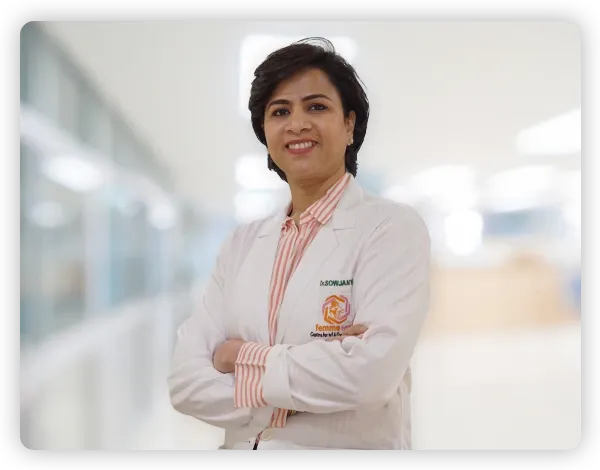
Director – IVF & Infertility, Laparoscopic & Robotic Gynae Surgery
Femme nest – Centre for IVF & Gynaecology
Max Super Speciality Hospital, Vaishali
Pushpanjali Medical Centre
 In-Vitro Fertilisation (IVF)
 Intrauterine Insemination (IUI)
 ICSI
ICSI PGS / PGD
 Male Infertility
 Laparoscopic Gynecology
 Robotic Gynecology
 General Gynecology
 Menopause
 Adolescent Care
 PCOS
PCOS Ovarian Cysts
 Fibroids
 Endometriosis
 Normal Delivery
 C-section Delivery
 High-risk PregnancyLow-risk Pregnancy
 Fetal Medicine
